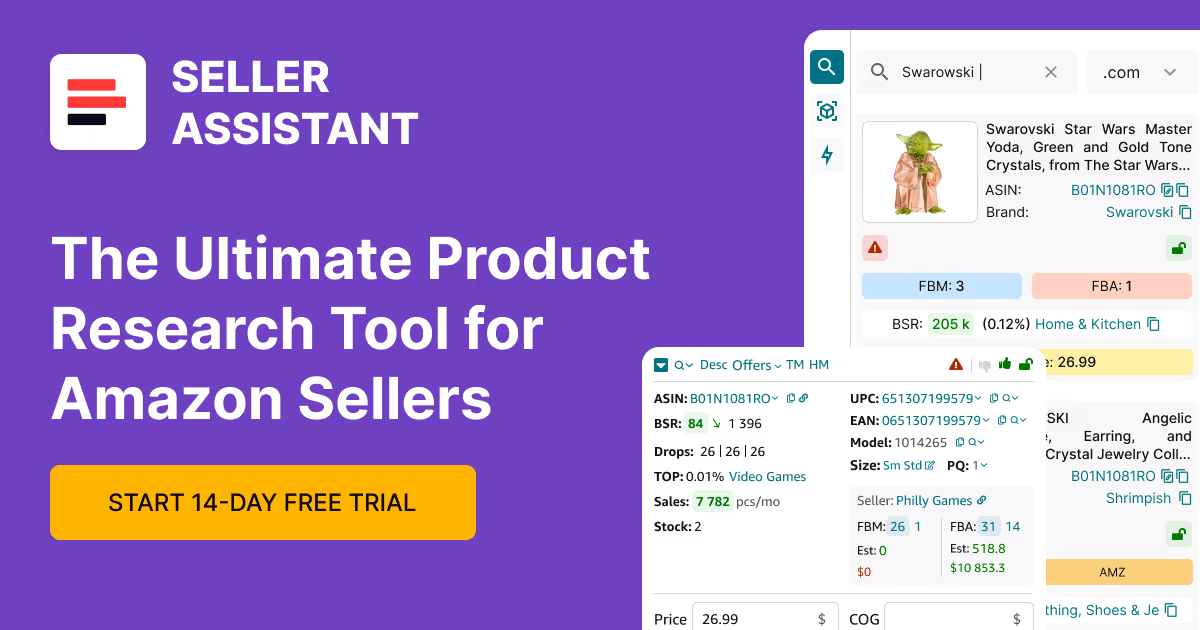



Brand Analyzer by Seller Assistant is a tool for evaluating Amazon brands before sourcing. It shows demand, competition, and reseller viability for up to 1,000 brands at once.
Most wholesale sellers don’t fail because they pick bad products. They fail because they spend too long on the wrong brands – gated catalogs, Amazon-controlled Buy Boxes, markets already saturated with 30 FBA sellers fighting for a margin that isn’t there.
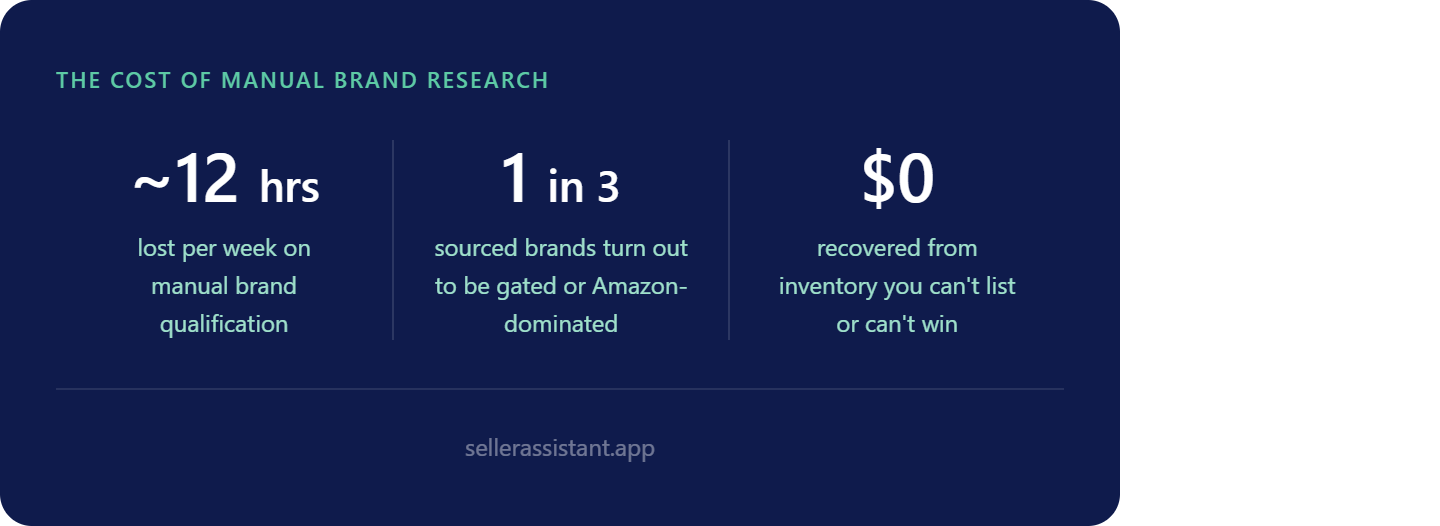
Seller Assistant’s Brand Analyzer runs the research you’d normally do manually – demand, competition, Amazon Buy Box share, reseller viability, catalog depth – across hundreds of brands at once. In minutes, you have a scored, prioritized shortlist. You only go deeper on brands worth your time.

What Is Seller Assistant’s Brand Analyzer?
Brand Analyzer by Seller Assistant is an Amazon wholesale brand research tool that helps wholesale sellers, online arbitrage sellers, and dropshippers identify brands worth sourcing. Instead of manually reviewing hundreds of products, sellers can analyze entire brands and quickly determine whether they meet their demand, competition, and profitability requirements.
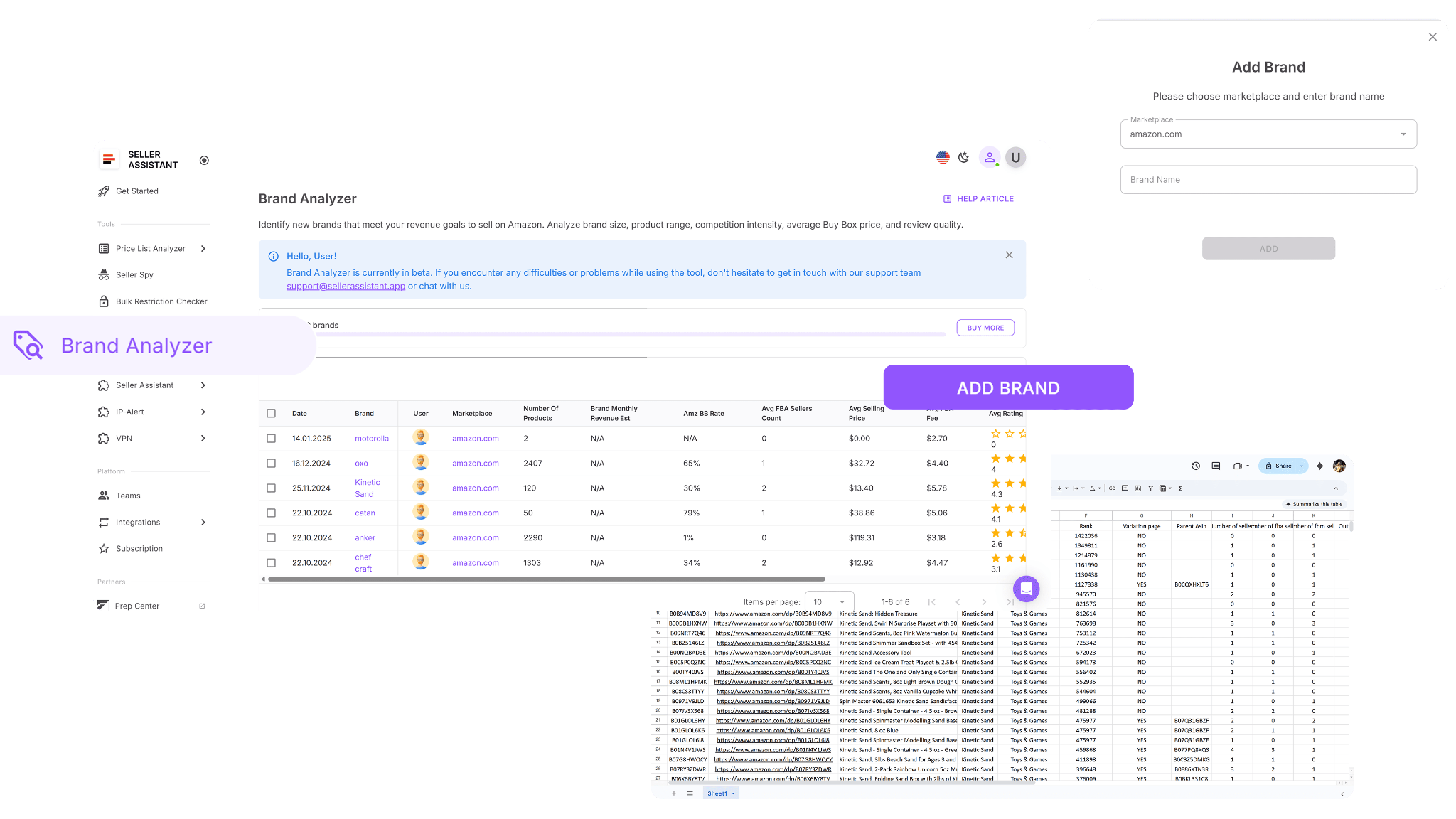
The tool provides a complete view of a brand’s Amazon performance, including estimated revenue, active catalog size, product count, seller competition, Amazon Buy Box rate, average price, FBA share, ratings, and distribution type. Sellers can analyze one brand or up to 1,000 brands at once, making it easy to evaluate supplier catalogs, distributor lists, and other large sourcing opportunities.
Brand Analyzer also includes AI-powered insights, such as a Resale Potential Score and AI-generated brand summaries that help prioritize opportunities faster. In addition, sellers can explore product-level analytics, discover suppliers connected to a brand, export detailed reports, and use Brand Reanalysis to refresh existing analyses with the latest marketplace data.
Benefits of Brand Analyzer
Successful wholesale sourcing starts with choosing the right brands. Brand Analyzer helps sellers evaluate opportunities faster, reduce research time, and make sourcing decisions based on data rather than guesswork. By combining brand-level analytics, AI-powered insights, product data, and supplier information, the tool helps sellers identify brands with the highest resale potential and avoid costly sourcing mistakes.
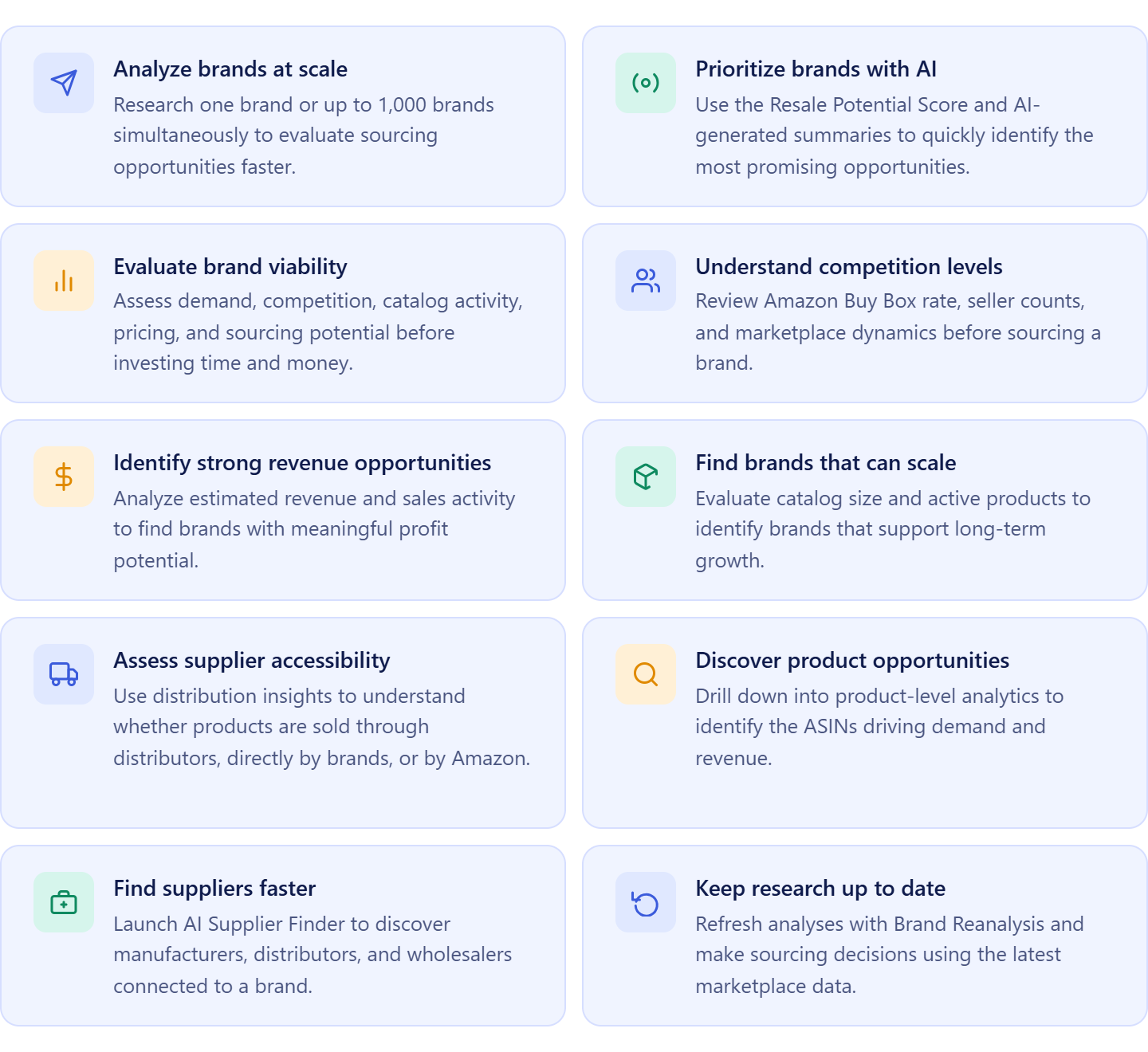
Analyze hundreds of brands in less time
Instead of researching brands one by one, sellers can analyze up to 1,000 brands simultaneously. This makes it easy to evaluate large supplier catalogs, distributor lists, competitor brands, and trade show prospects.
Identify reseller-friendly brands faster
Brand Analyzer helps sellers quickly determine whether a brand is suitable for resale by evaluating competition, demand, pricing, and distribution patterns in one place.
Prioritize opportunities with AI
The Resale Potential Score and AI-generated brand summary help sellers focus on the most promising opportunities without manually interpreting dozens of metrics.
Understand competition before sourcing
Sellers can evaluate Amazon Buy Box presence, average seller counts, and marketplace competition before contacting suppliers or investing in inventory.
Find brands with strong demand
Estimated revenue, active catalog percentage, and product activity metrics help identify brands that generate consistent sales and support long-term growth.
Discover scalable sourcing opportunities
By analyzing product count, catalog depth, and overall brand performance, sellers can identify brands with enough products to expand their business over time.
Evaluate supplier accessibility
Distribution type insights help sellers understand whether products are sold through distributors, directly by brands, or heavily controlled by Amazon, making supplier research more efficient.
Explore products within a qualified brand
Once a brand passes initial screening, sellers can drill down into product-level analytics to identify the ASINs that drive demand and revenue.
Connect research with supplier discovery
Brand Analyzer integrates with AI Supplier Finder, allowing sellers to move directly from brand research to finding manufacturers, distributors, and wholesalers.
Keep brand research up to date
With Brand Reanalysis, sellers can refresh existing analyses using the latest marketplace data. This helps ensure sourcing decisions are based on current competition, demand, pricing, and Amazon activity rather than outdated information.
What Brand Analyzer Shows
Brand Analyzer combines brand-level intelligence, AI-powered insights, product analytics, and supplier data to help sellers evaluate whether a brand is worth sourcing. Instead of relying on a few isolated data points, the tool provides a complete picture of a brand’s demand, competition, catalog strength, pricing environment, and supplier accessibility.
Brand performance and market size
The Insights dashboard helps sellers understand the overall scale and health of a brand. It shows key business metrics such as estimated monthly revenue, number of products, active catalog percentage, average selling price, average rating, and category.
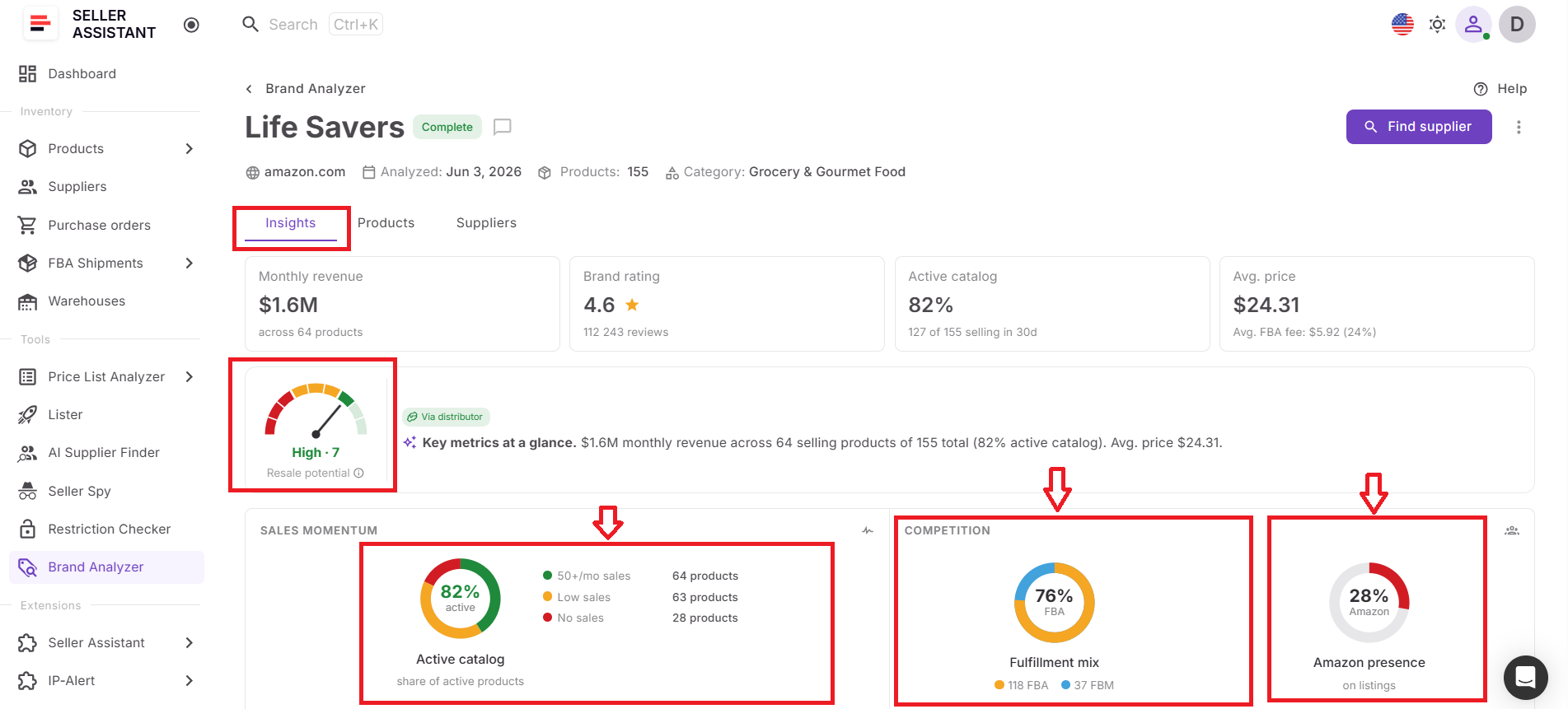
These metrics help sellers determine whether a brand generates enough sales activity, has sufficient catalog depth, and offers enough growth potential to support wholesale sourcing.
Competition and Amazon presence
Competition data helps sellers assess how difficult it may be to compete within a brand.
Brand Analyzer displays metrics such as average seller count, Amazon Buy Box rate, FBA percentage, and top brand sellers. Together, these indicators reveal whether Amazon frequently competes on listings, how crowded the marketplace is, and whether third-party sellers have room to succeed.
Distribution insights
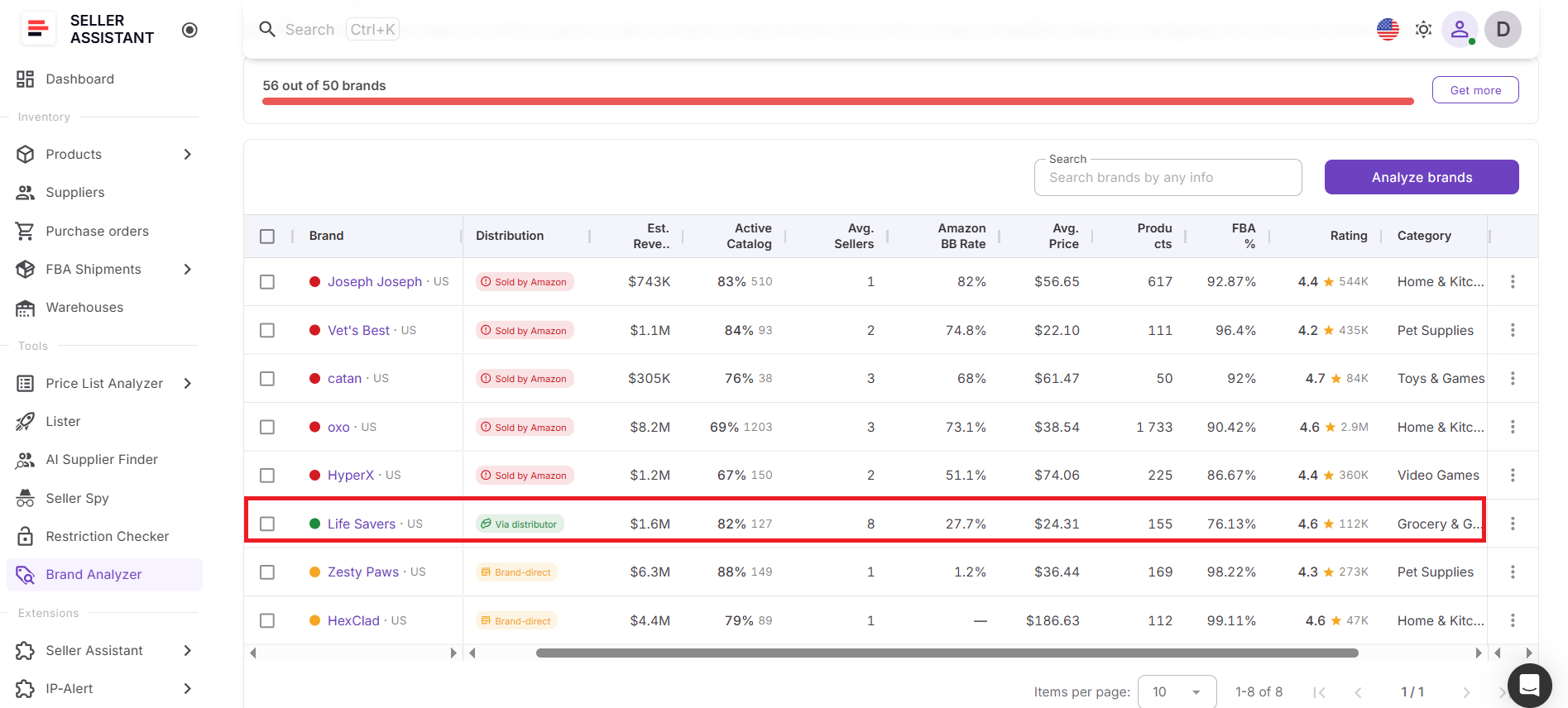
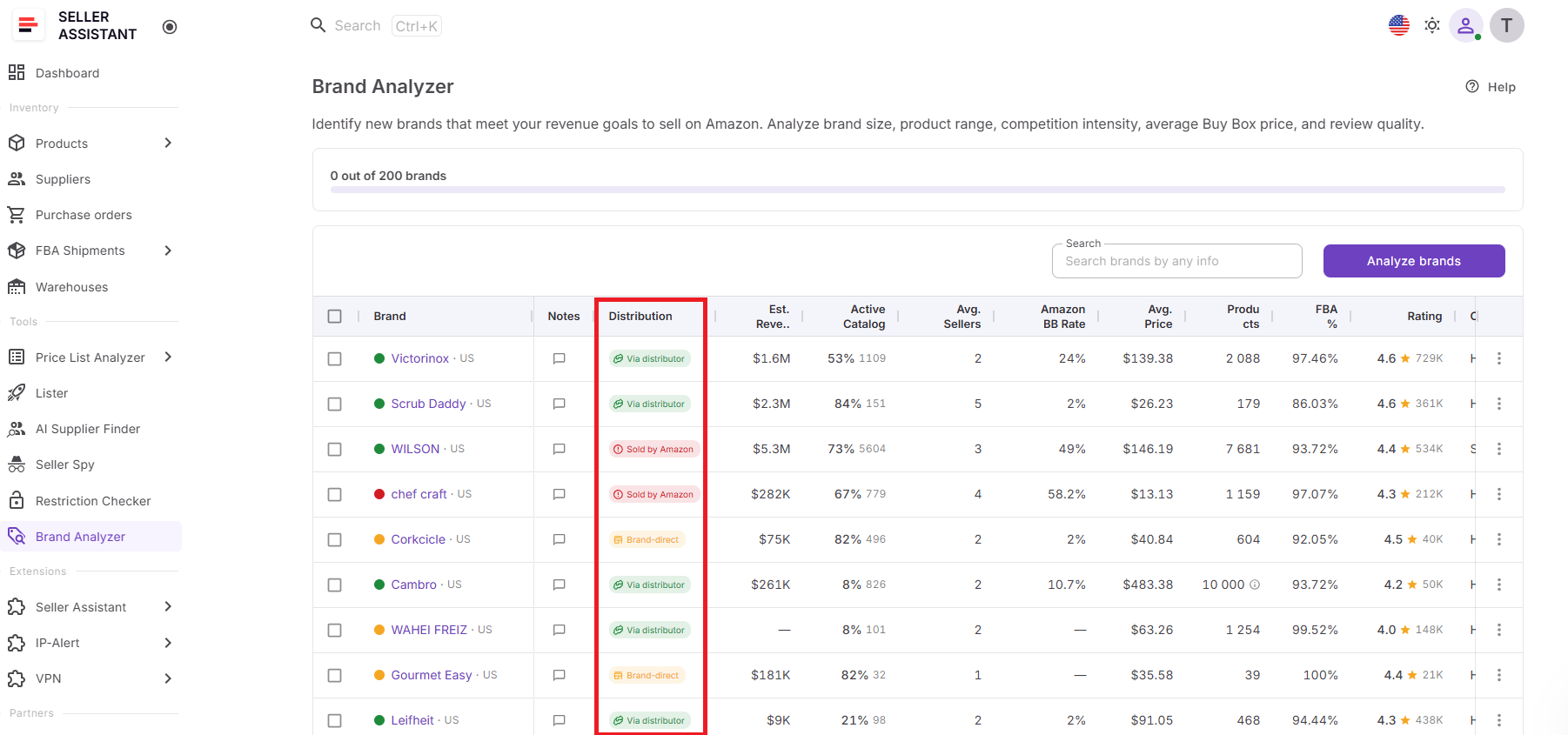
Brand Analyzer also helps sellers understand how products reach the market through its Distribution Type classification.
Brands are categorized as:
- Sold by Amazon
- Brand-direct
- Via distributor
This provides valuable insight into supplier accessibility and helps sellers determine whether a brand is likely to be reseller-friendly.
AI-powered opportunity assessment
To simplify decision-making, Brand Analyzer automatically generates a Resale Potential Score and an AI-generated brand summary.
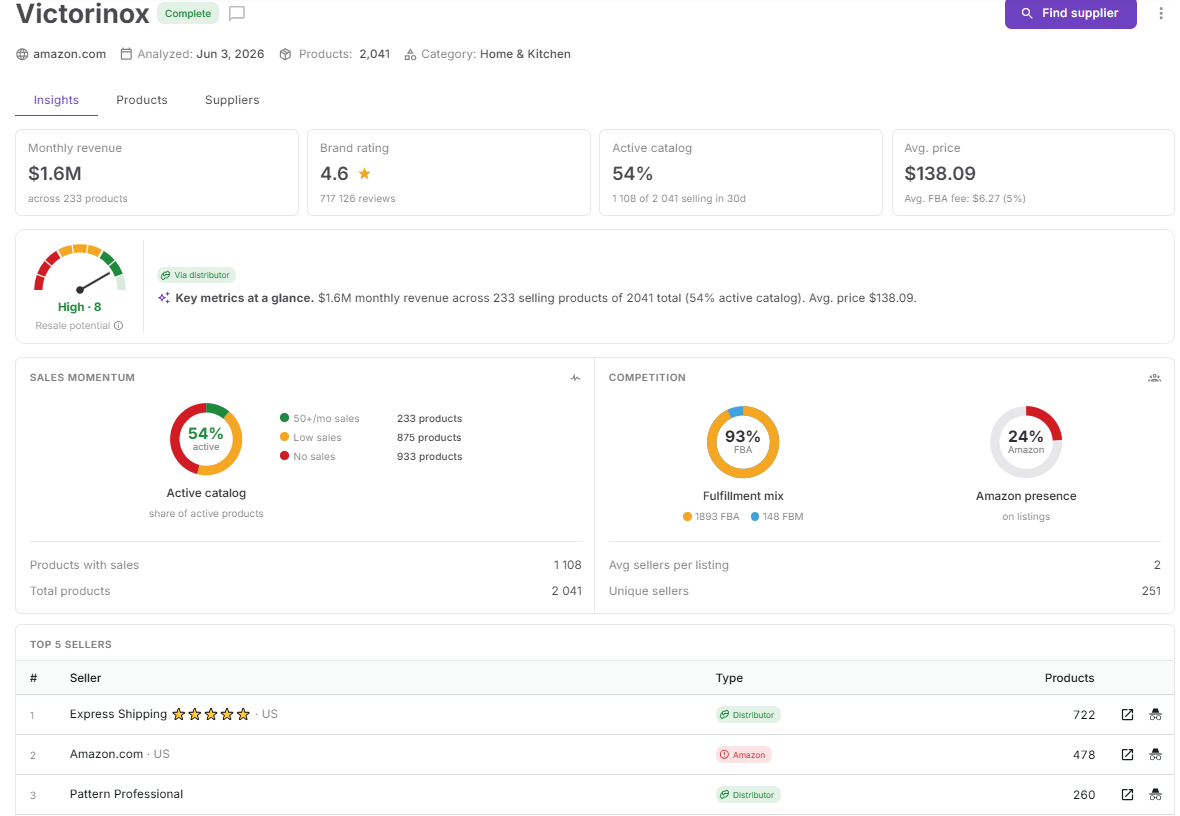
The score is calculated using multiple marketplace signals, including Amazon competition, seller count, average price point, sales velocity, market size, FBA share, and top sellers within the brand. Based on these factors, each brand is classified as High, Medium, or Low potential.
Product-level analytics
The Products dashboard provides detailed information about every product within a brand’s catalog.
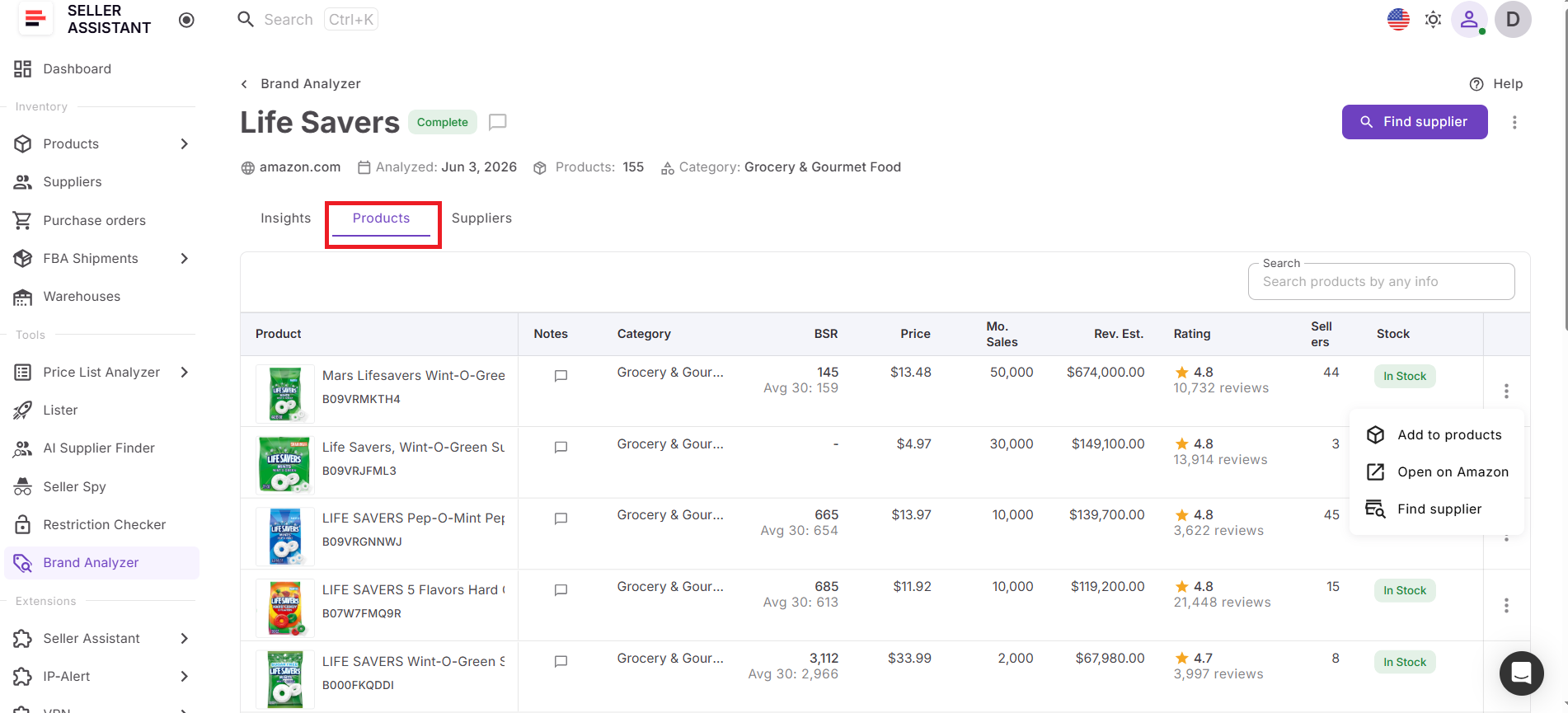
Available product metrics include:
- ASIN
- Product title
- Brand
- Category
- Parent ASIN
- Variation page
- Product image
- Product link
- Buy Box seller
- In Buy Box status
- Number of sellers
- Out-of-stock status
- Buy Box price
- Average Buy Box price over 30, 90, 180, and 365 days
- Estimated monthly revenue
- Rating
- Review count
- BSR
- Average BSR over 30, 90, 180, and 365 days
- Sales rank drops over 30, 90, 180, and 365 days
- Price dynamics
- Launch date
- UPC
- EAN
- Model number
These metrics help sellers identify the products driving demand within a brand and uncover opportunities that align with their sourcing goals.
Supplier intelligence
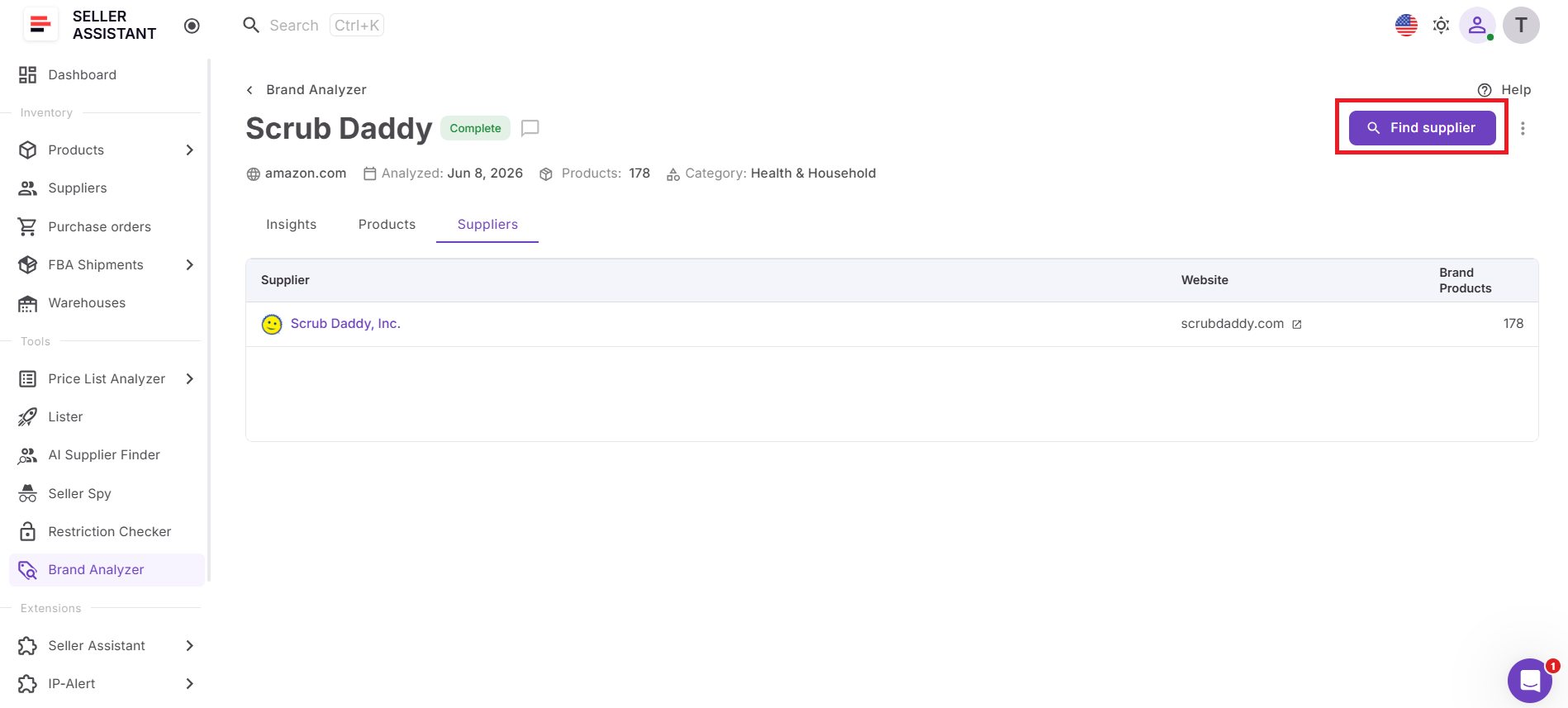
The Suppliers dashboard connects brand research with sourcing execution. Sellers can review supplier information related to analyzed brands and launch AI Supplier Finder to identify manufacturers, distributors, wholesalers, and other potential supply sources.
Exportable reports and ongoing monitoring
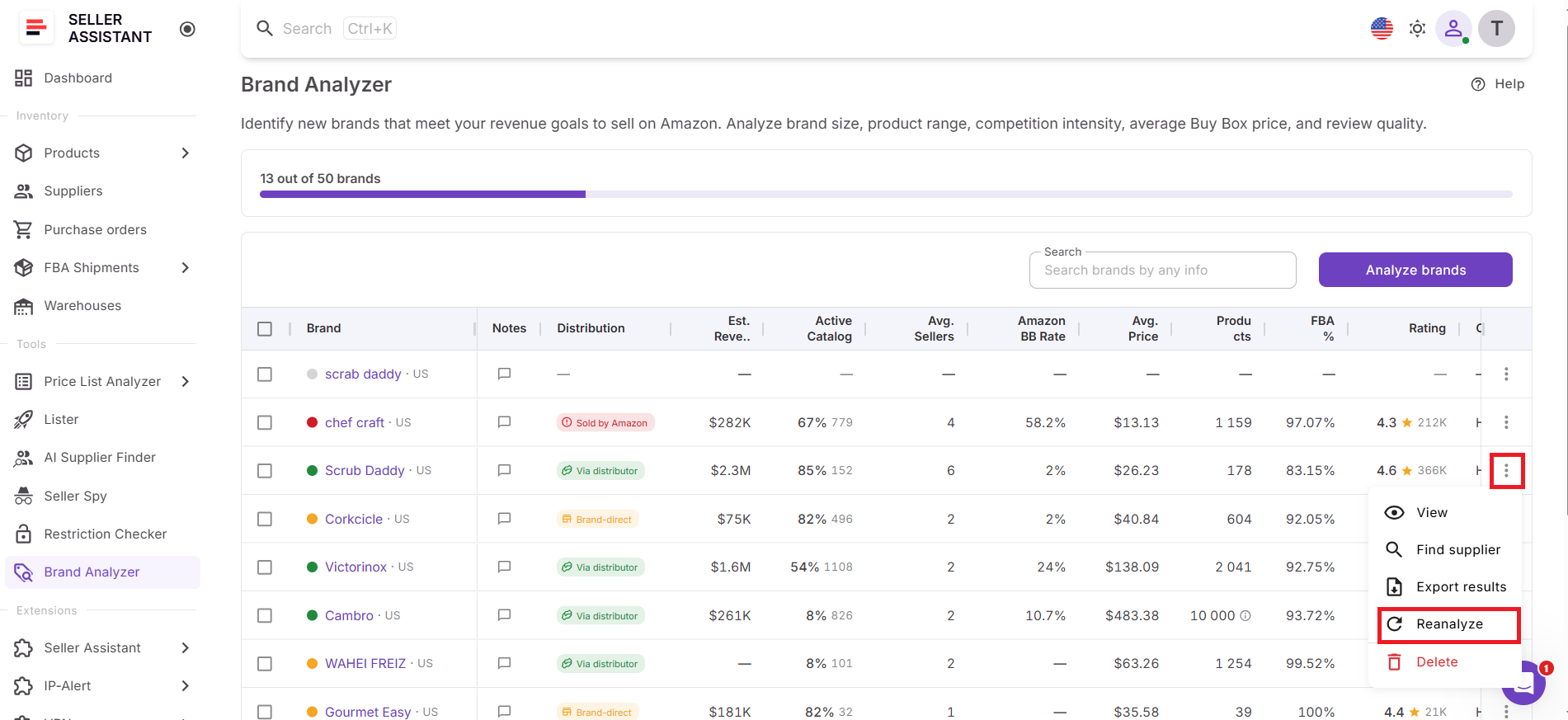
All brand and product data can be exported to Excel for additional filtering and analysis. Brand Analyzer also includes Brand Reanalysis, allowing sellers to refresh an existing analysis, update all metrics, recalculate the Resale Potential Score, and generate a new AI summary using the latest marketplace data.
Brand Analyzer Use Cases
Brand Analyzer can be used at every stage of the sourcing process, from discovering new brands to validating opportunities before placing orders. Whether you’re a wholesale seller, online arbitrage seller, or dropshipper, the tool helps you make faster and more informed decisions based on real marketplace data.
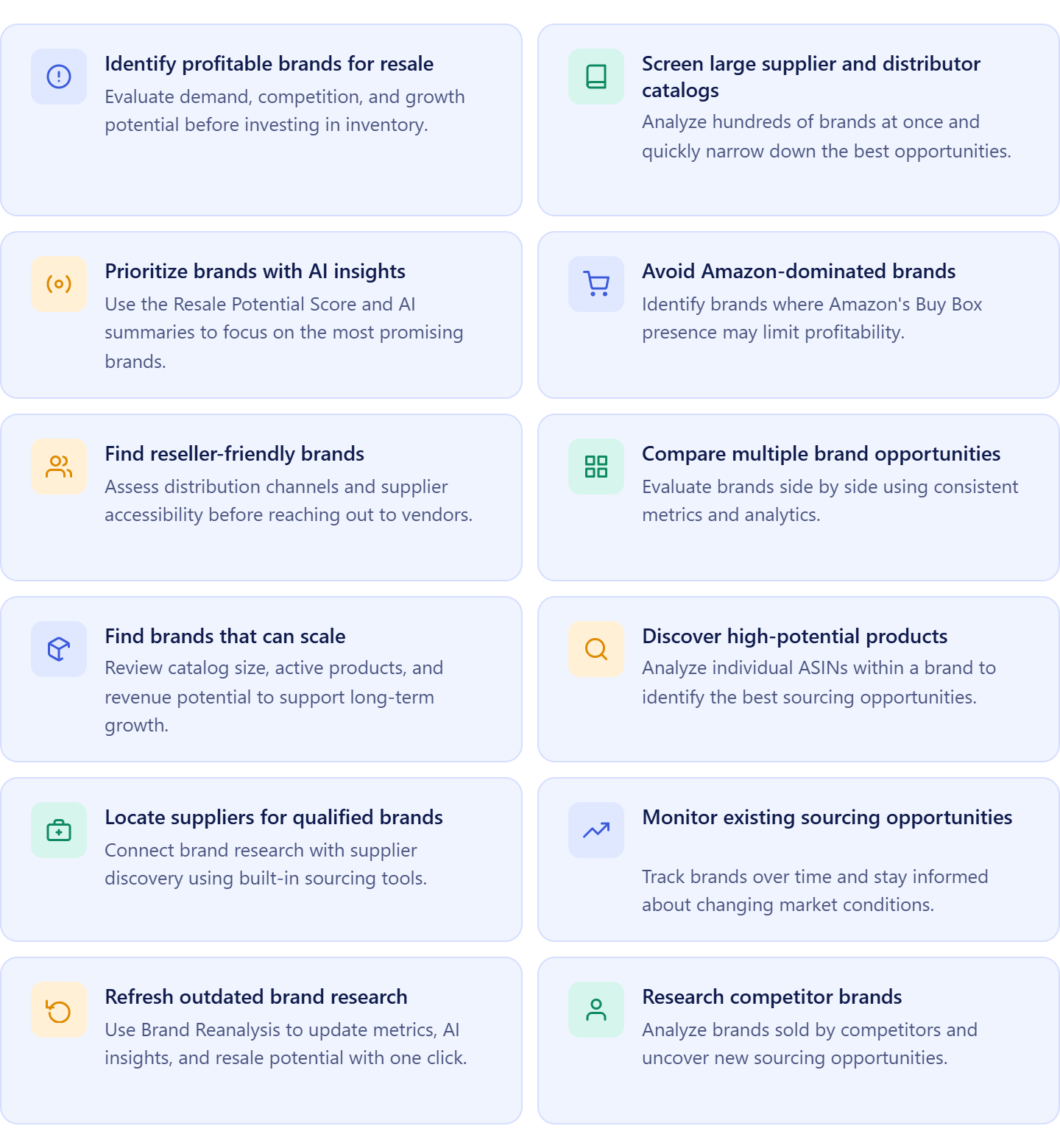
Identifying profitable brands for resale
Use case
An Amazon seller wants to expand their product portfolio with new brands that offer strong demand and long-term growth potential.
Solution
Brand Analyzer helps evaluate revenue potential, competition levels, catalog activity, and reseller accessibility. Sellers can quickly determine whether a brand meets their sourcing criteria before investing time in supplier outreach.
Screening distributor catalogs
Use case
A wholesale seller receives a distributor catalog containing hundreds of brands and needs to identify which ones are worth pursuing.
Solution
By analyzing multiple brands at once, Brand Analyzer helps sellers filter out weak opportunities and focus on brands with strong demand, manageable competition, and favorable distribution structures.
Prioritizing supplier outreach
Use case
A seller has identified several potential brands but doesn’t know which suppliers to contact first.
Solution
Brand Analyzer’s Resale Potential Score, AI summaries, and brand-level metrics help prioritize the brands most likely to generate profitable opportunities.
Avoiding Amazon-dominated brands
Use case
A seller wants to avoid brands where Amazon Retail frequently controls the Buy Box.
Solution
Brand Analyzer displays Amazon Buy Box rate and competition metrics, helping sellers identify brands where Amazon’s presence may limit profitability.
Finding reseller-friendly brands
Use case
A seller wants to identify brands that are easier to source through wholesale channels.
Solution
The Distribution Type insight shows whether products are primarily sold by Amazon, directly by the brand, or through distributors, helping sellers assess supplier accessibility.
Comparing multiple sourcing opportunities
Use case
A seller is evaluating several brands and needs an objective way to compare them.
Solution
Brand Analyzer provides standardized metrics and AI-generated insights that make it easy to compare revenue potential, competition, catalog size, and overall opportunity across brands.
Identifying brands that can scale
Use case
A seller wants to build long-term supplier relationships and expand beyond a handful of products.
Solution
Brand Analyzer reveals catalog size, active catalog percentage, and product count, helping sellers identify brands with enough depth to support future growth.
Discovering high-potential products within a brand
Use case
A seller has qualified a brand and wants to identify the best products to source.
Solution
The Products dashboard provides product-level analytics, including revenue estimates, sales performance, competition data, Buy Box metrics, BSR trends, and customer feedback, helping sellers uncover the strongest opportunities.
Finding suppliers for validated brands
Use case
A seller has identified a promising brand but doesn’t know where to source it.
Solution
The Suppliers dashboard and AI Supplier Finder help locate manufacturers, distributors, wholesalers, and other supply sources connected to the brand.
Monitoring existing sourcing opportunities
Use case
A seller wants to keep track of brands already researched and ensure conditions haven’t changed.
Solution
Brand Analyzer stores brand analyses and allows sellers to revisit opportunities whenever needed. This helps maintain an organized and actionable sourcing pipeline.
Refreshing outdated brand research
Use case
A seller analyzed a brand several weeks ago and wants to verify that it still meets their sourcing criteria.
Solution
Using Brand Reanalysis, sellers can update an existing analysis in one click. Brand Analyzer refreshes metrics, recalculates the Resale Potential Score, and generates a new AI summary using the latest marketplace data.
Researching competitor brands
Use case
A seller wants to identify brands successfully sold by competitors and evaluate whether they are worth sourcing.
Solution
Brand Analyzer allows sellers to analyze competitor brands, assess demand and competition levels, and discover opportunities that fit their business model.
Preparing for wholesale account applications
Use case
A seller wants to ensure a brand is worth pursuing before spending time opening a wholesale account.
Solution
Brand Analyzer provides a complete picture of demand, competition, pricing, catalog activity, and sourcing potential, helping sellers validate opportunities before committing resources.
How Does Brand Analyzer Work?
Brand Analyzer follows a structured workflow that helps sellers move from brand discovery to sourcing decisions. Instead of manually collecting data from dozens of listings, the tool analyzes brands at multiple levels – from overall brand performance and AI-powered opportunity assessment to product analytics and supplier discovery.
This allows sellers to quickly determine whether a brand is worth pursuing and identify the best opportunities within its catalog.
Step 1. Open Brand Analyzer
Access Brand Analyzer from your Seller Assistant account.
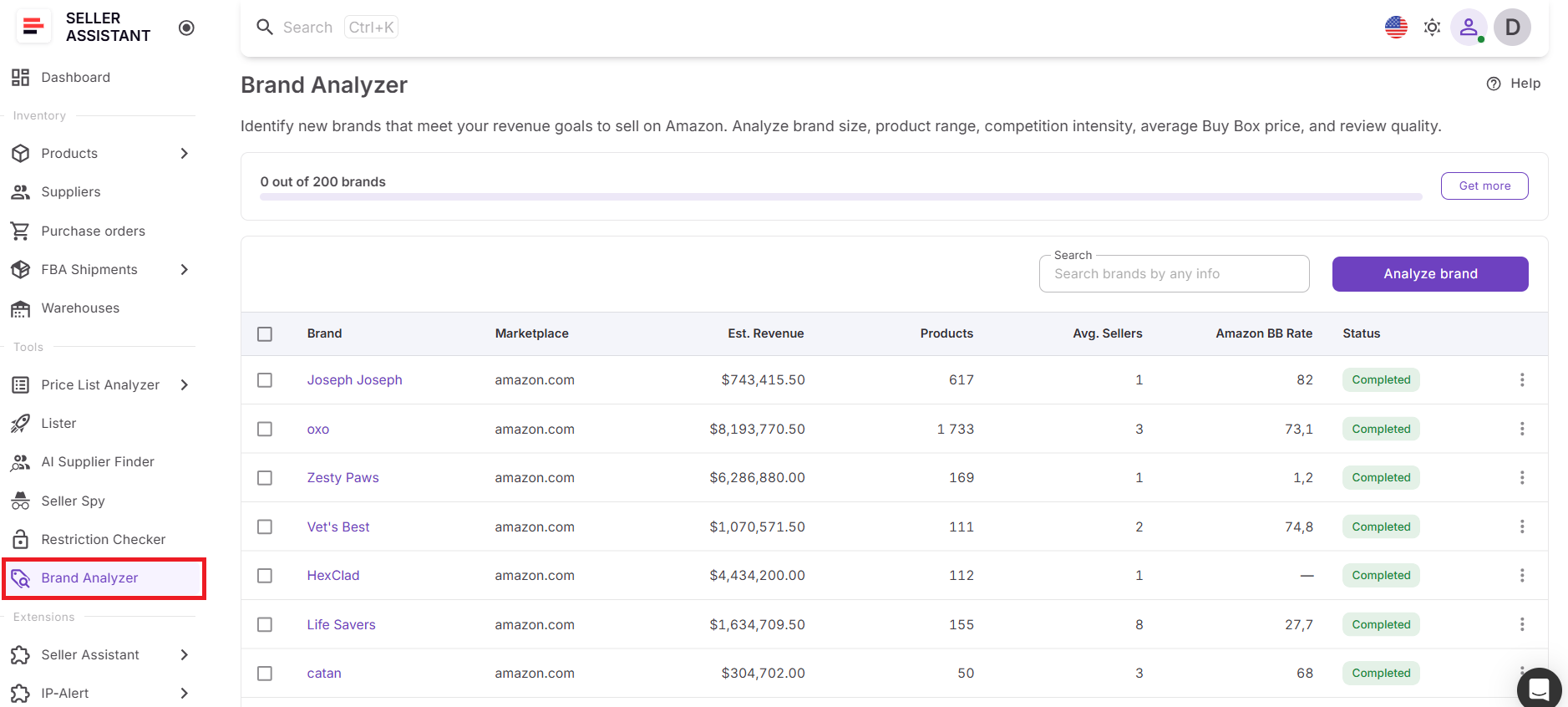
This is where all brand research, analysis, and monitoring activities are managed in a single workspace.
Step 2. Select your Amazon marketplace
Choose the marketplace where you want to evaluate the brand.
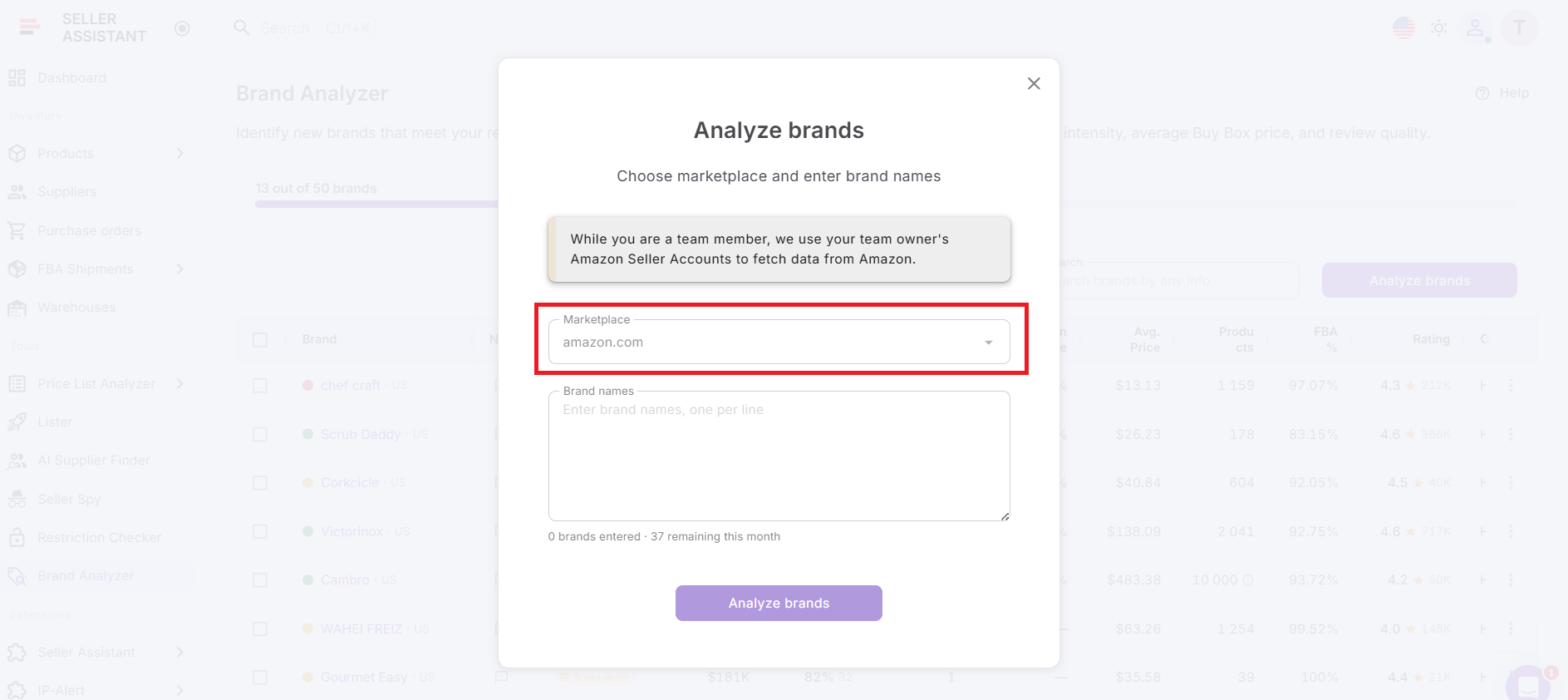
This is important because demand, competition, pricing, and Amazon’s Buy Box presence can vary significantly between marketplaces.
Step 3. Add brands to analyze
Enter a single brand or upload a list containing up to 1,000 brands.
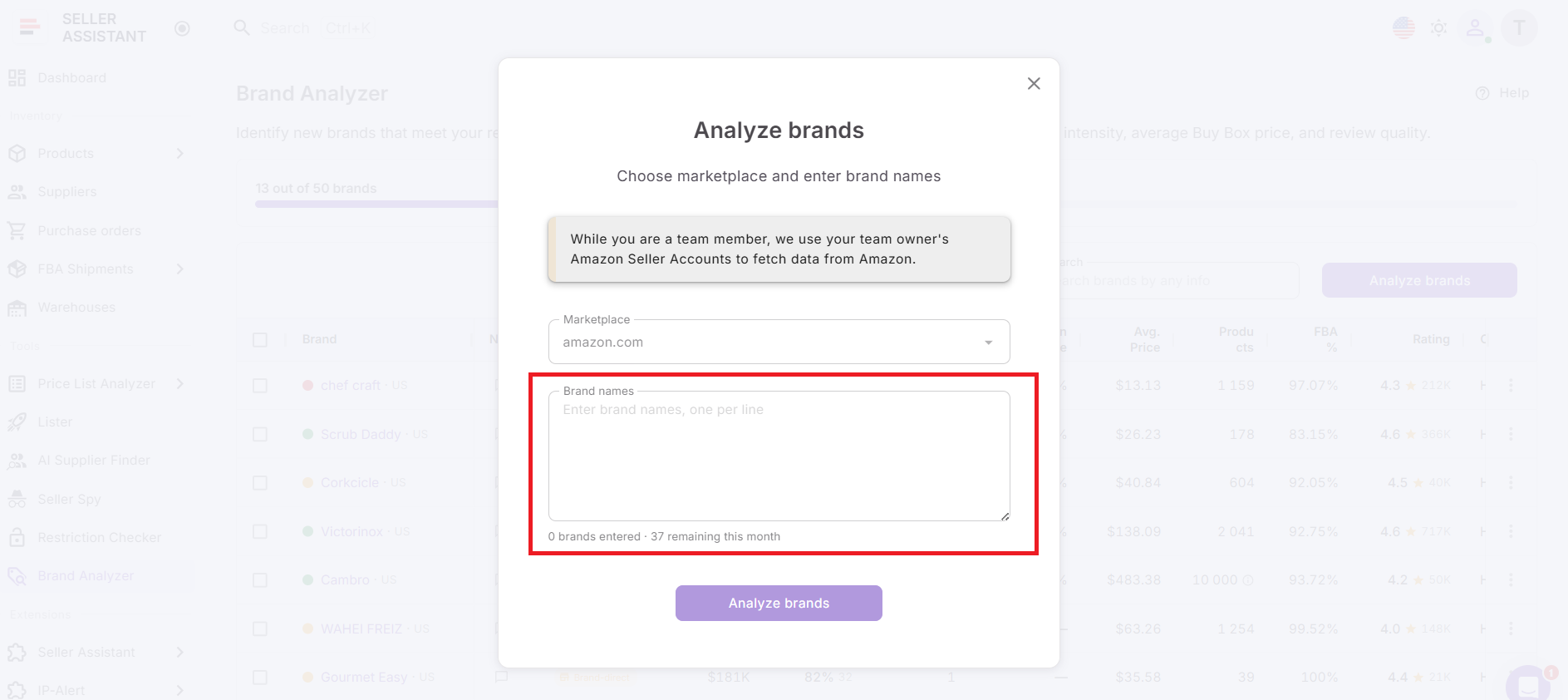
This allows sellers to research opportunities individually or evaluate large supplier catalogs, distributor lists, and competitor brands at scale.
Step 4. Launch the analysis
Start the analysis and let Brand Analyzer collect and process marketplace data.
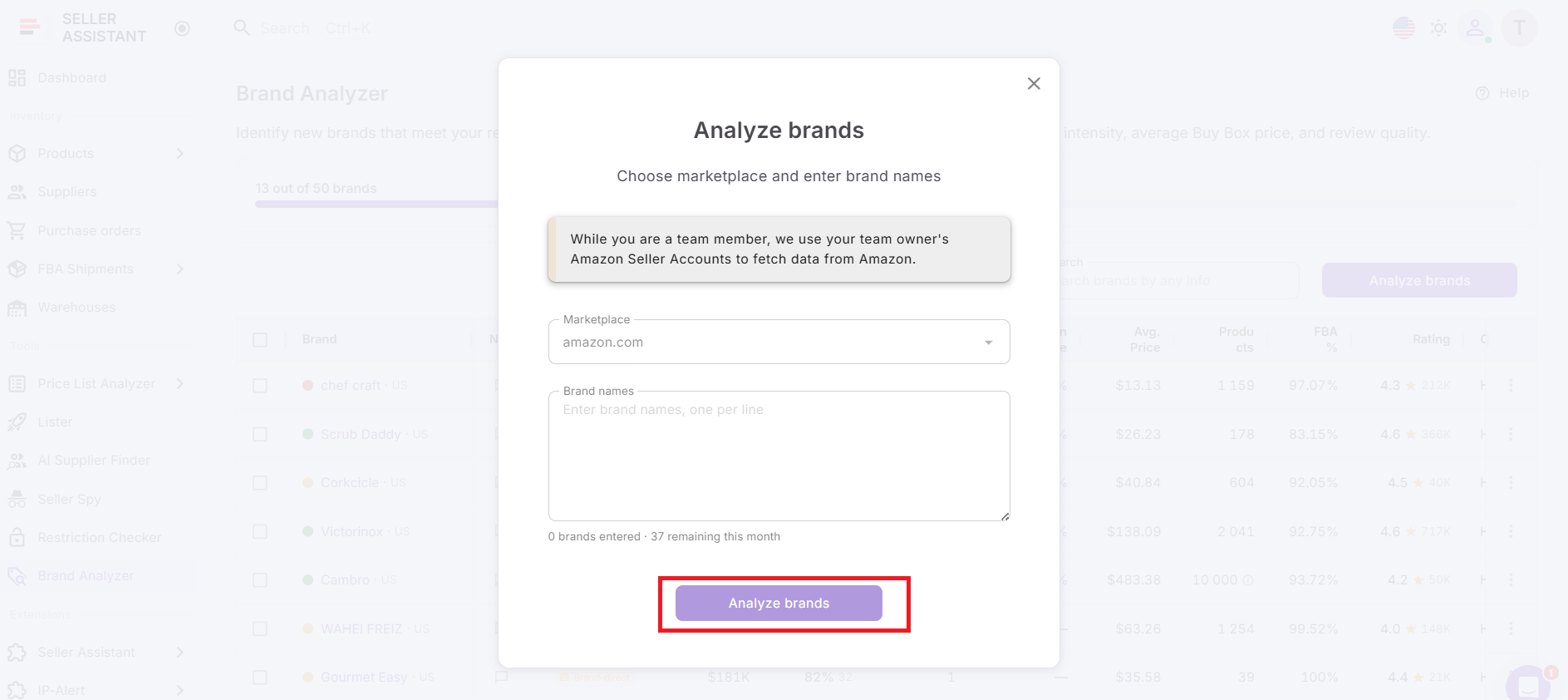
The tool analyzes multiple brands simultaneously and can reuse recent analyses when available, helping sellers save time.
Step 5. Review the Insights dashboard
Open the Insights dashboard once the analysis is complete.
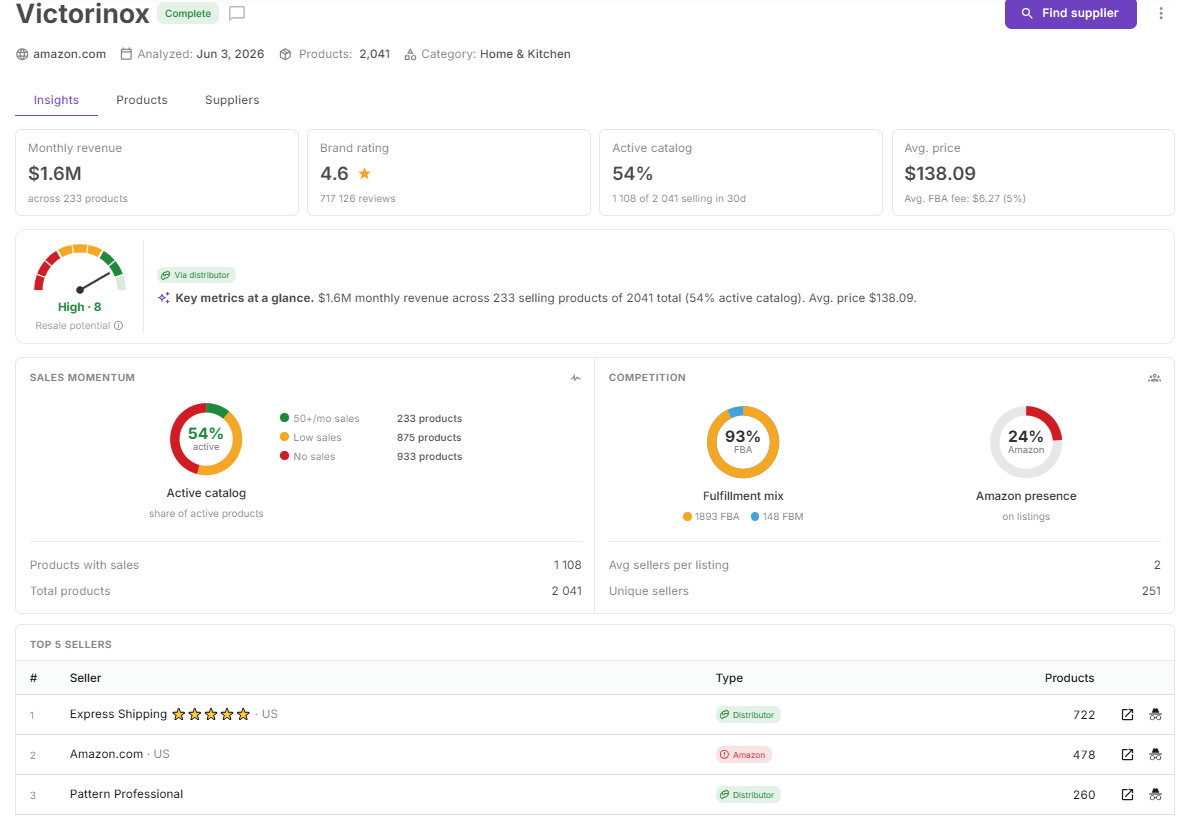
This dashboard provides a high-level view of the brand’s revenue potential, competition, catalog activity, pricing environment, and distribution structure, helping sellers decide whether the brand deserves deeper investigation.
Step 6. Evaluate AI-powered insights
Check the Resale Potential Score and AI-generated brand summary.
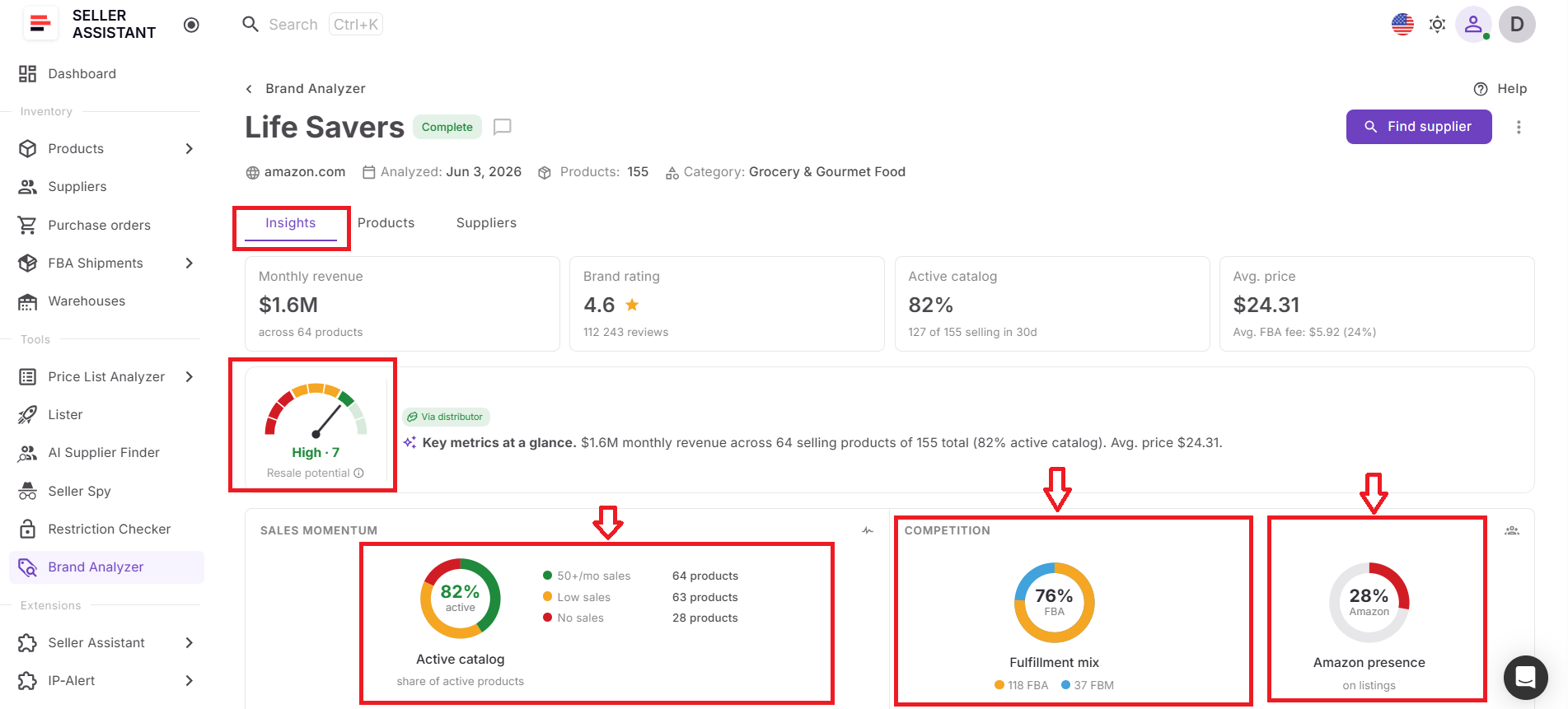
These insights help sellers quickly understand the brand’s overall sourcing potential and prioritize opportunities without manually interpreting every metric.
Step 7. Assess key brand metrics
Review metrics such as estimated revenue, active catalog percentage, seller count, Amazon Buy Box rate, average price, FBA share, ratings, category, and distribution type.
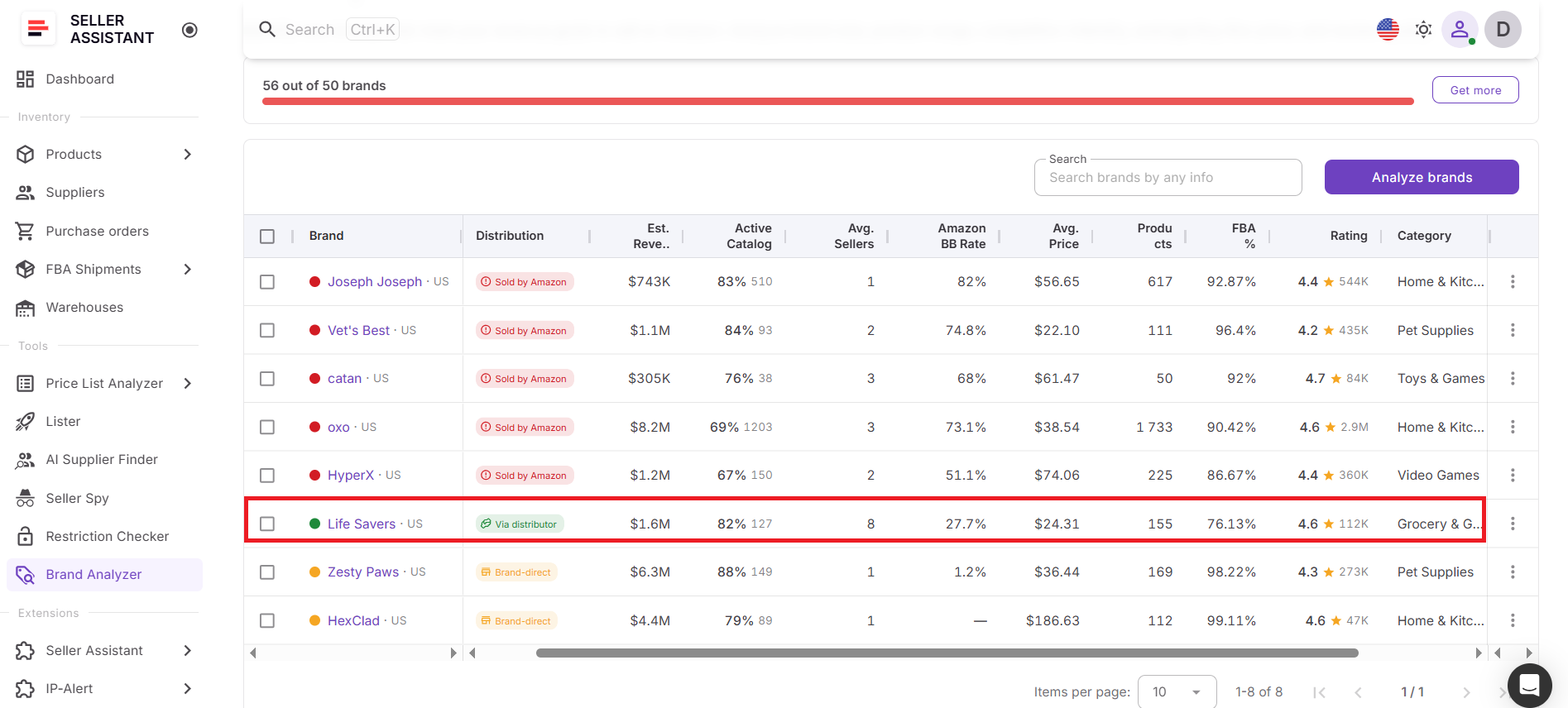
Together, these metrics reveal whether a brand has enough demand, manageable competition, and sufficient growth potential for wholesale sourcing.
Step 8. Explore the Products dashboard
Move to the Products dashboard to analyze the brand’s catalog in greater detail.
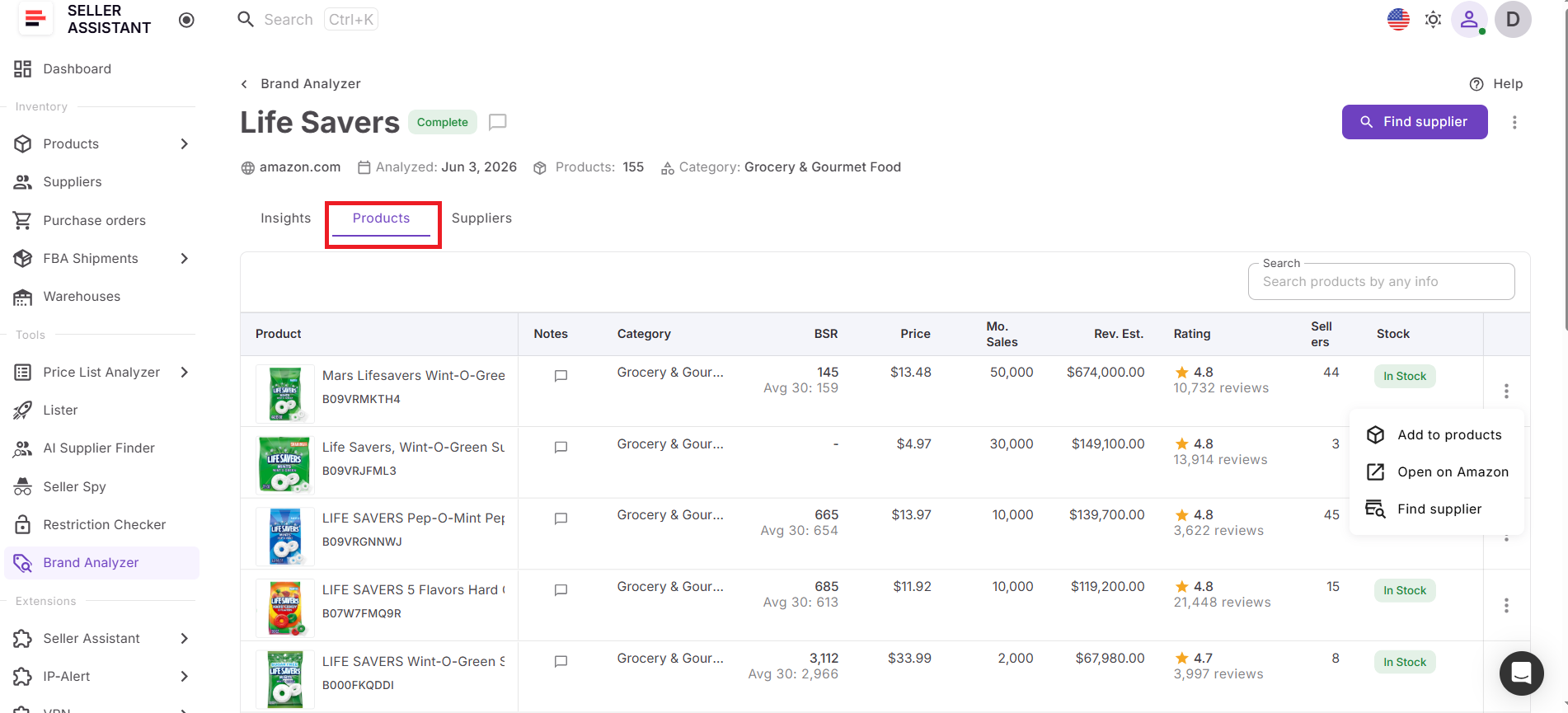
Product-level analytics help identify the ASINs driving demand, revenue, and sales activity while highlighting specific products worth sourcing.
Step 9. Check supplier opportunities
Open the Suppliers dashboard and launch AI Supplier Finder.
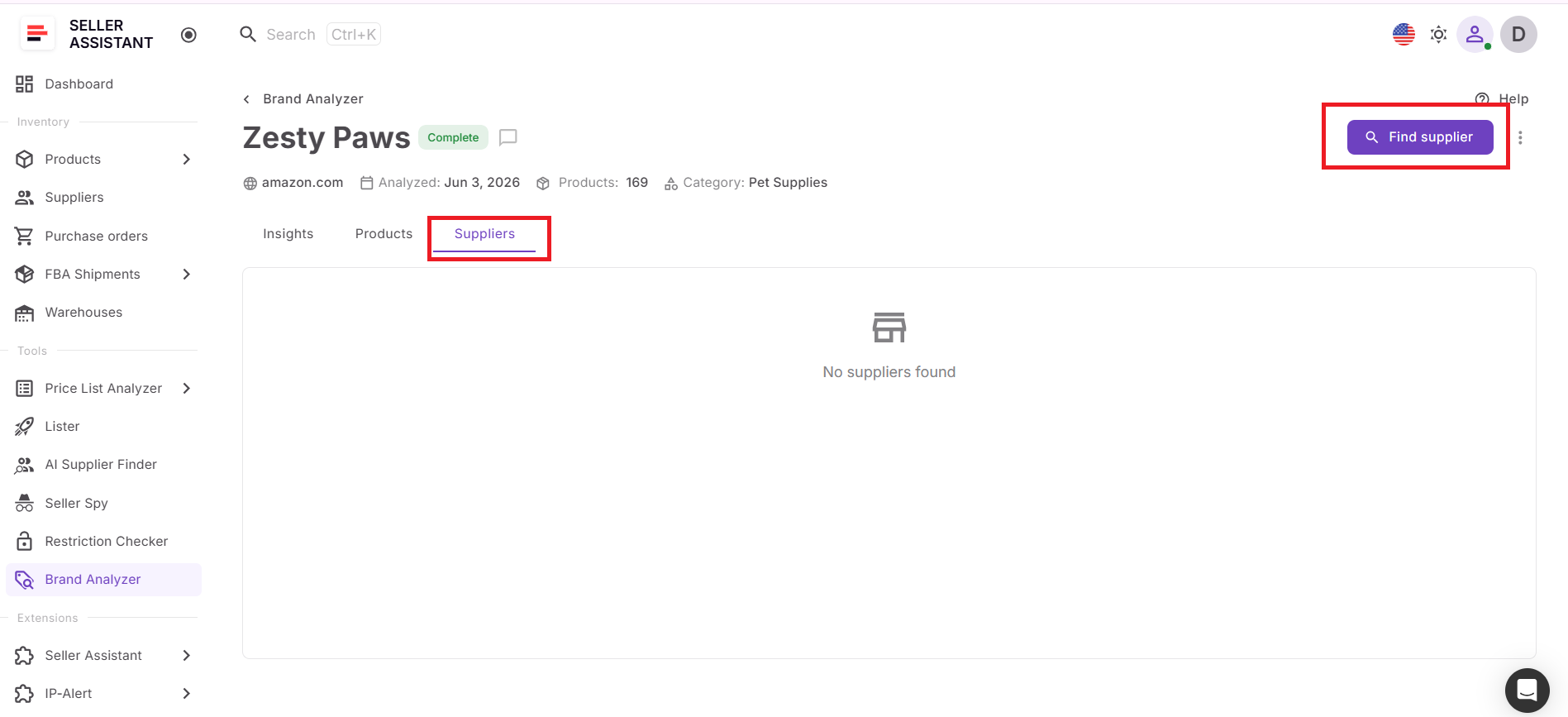
This helps sellers move directly from brand validation to supplier discovery and identify potential manufacturers, distributors, and wholesalers.
Step 10. Export and share results
Download the analysis results when deeper review is needed.
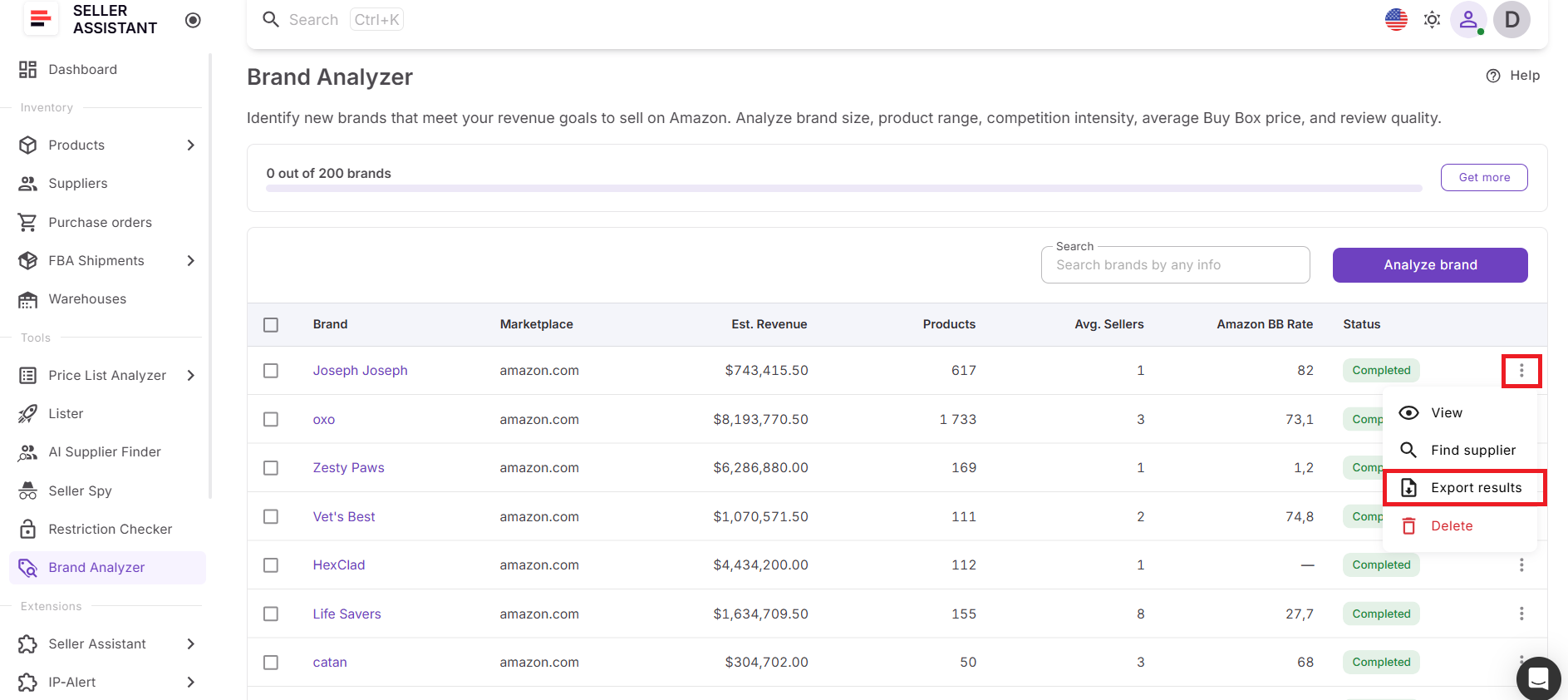
Exported data makes it easier to compare opportunities, collaborate with team members, and incorporate brand research into broader sourcing workflows.
Step 11. Refresh brand data when needed
Use Brand Reanalysis by opening the three-dot menu next to a brand and clicking Reanalyze.
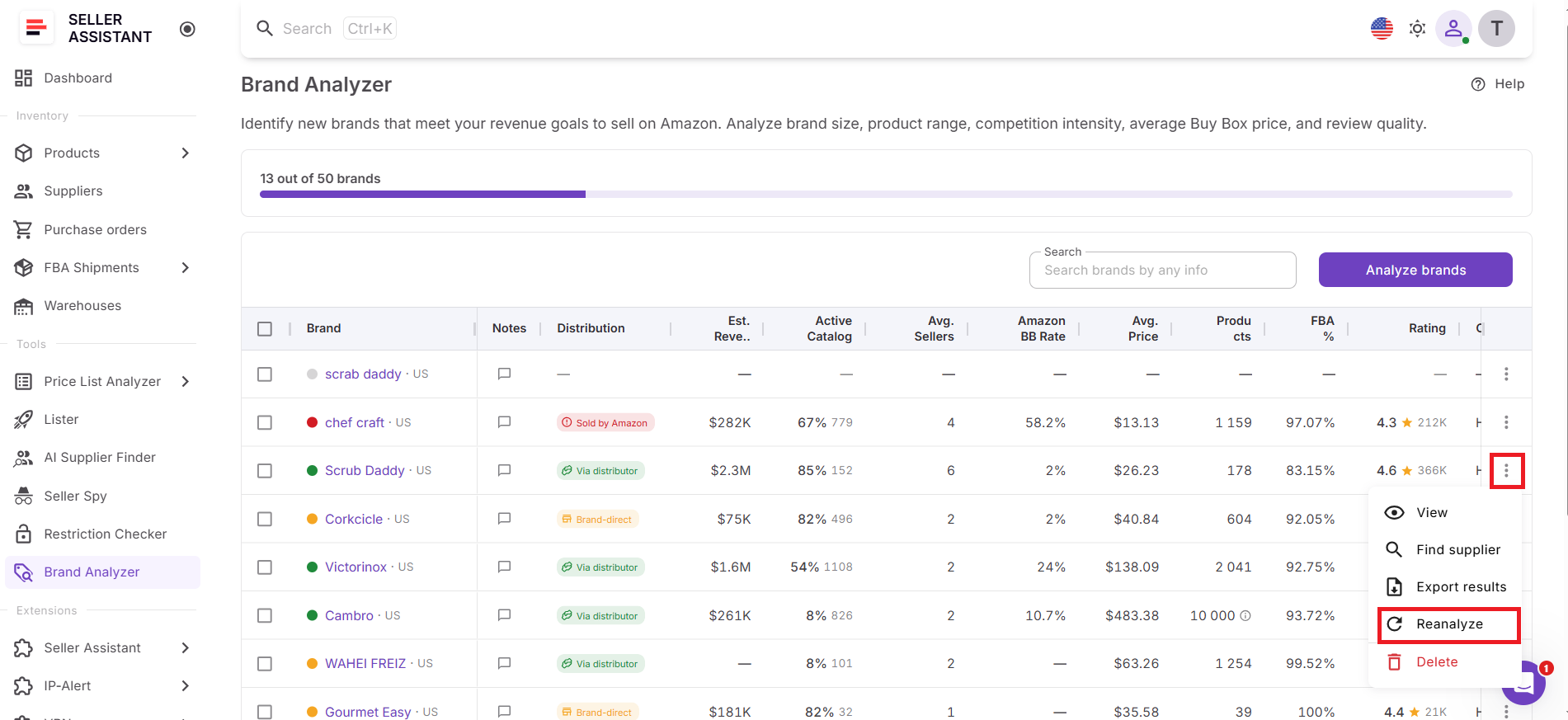
This updates the analysis with the latest marketplace data, helping sellers keep their brand research current and make decisions based on the most recent information available.
FAQ
How often should I reanalyze a brand?
There is no fixed schedule because it depends on how actively you’re sourcing from that brand. Many sellers refresh analyses before contacting suppliers, reviewing price lists, negotiating terms, or placing large inventory orders to ensure market conditions haven’t changed.
Can I use Brand Analyzer before I have a supplier?
Yes. Many sellers use Brand Analyzer to validate brands first and only begin supplier research after finding brands with strong resale potential. This helps avoid spending time searching for suppliers for brands that don’t meet their sourcing criteria.
What does it mean if a brand has high revenue but a low Resale Potential Score?
High revenue alone doesn’t always make a brand attractive for resale. The score also considers factors such as Amazon competition, seller saturation, pricing environment, and fulfillment patterns, which may reduce the opportunity for third-party sellers.
Can Brand Analyzer help me discover brands I wasn’t previously considering?
Yes. Many sellers use it to evaluate brands found in competitor storefronts, distributor catalogs, trade show exhibitor lists, and niche product categories. This makes it useful not only for validation but also for uncovering new sourcing opportunities.
Should I analyze products if a brand doesn’t look attractive?
In most cases, no. If brand-level metrics indicate weak demand, excessive competition, or limited sourcing potential, it’s usually more efficient to move on to another brand rather than spend additional time analyzing individual products.
Final Thoughts
Finding profitable products starts with finding the right brands. Brand Analyzer helps Amazon sellers make smarter sourcing decisions by providing a complete view of brand performance, competition, demand, supplier accessibility, and resale potential before they invest time in product research or supplier outreach.
With bulk brand analysis, AI-powered insights, detailed brand and product analytics, supplier discovery, and Brand Reanalysis, Seller Assistant transforms brand research into a structured sourcing workflow. Whether you’re evaluating a new supplier catalog, researching competitor brands, or monitoring existing opportunities, Brand Analyzer helps you identify better brands faster, prioritize the most promising opportunities, and make sourcing decisions based on current marketplace data.
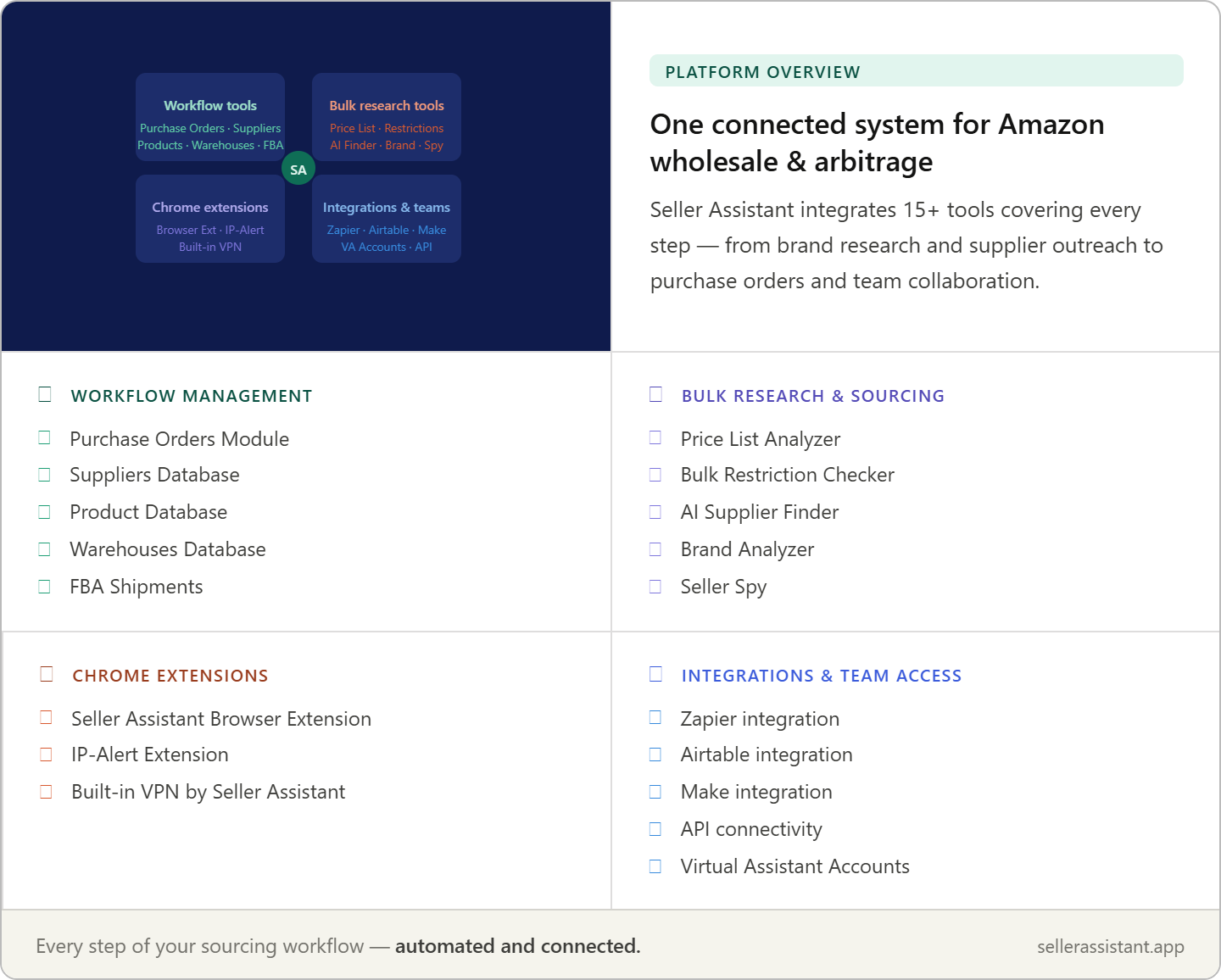
Seller Assistant automates and connects every stage of your Amazon wholesale and arbitrage workflow. It brings together in one platform: workflow management tools – Purchase Orders Module, Suppliers Database, Product Database, Warehouses Database, FBA Shipments, bulk research & sourcing tools – Price List Analyzer, Bulk Restriction Checker, AI Supplier Finder, Brand Analyzer, Seller Spy, Chrome extensions – Seller Assistant Browser Extension, IP-Alert Extension, and built-in VPN by Seller Assistant, and integrations & team access features – seamless API connectivity, integrations with Zapier, Airtable, and Make, and Virtual Assistant Accounts.